Author Archives: alistair

Should we use geo-engineering to escape global warming?

Geo-engineering is the practice of using technology to alter the properties (in this case climate) of the planet. We have actually been doing it inadvertently for centuries – global warming itself is an example of geo-engineering. When plants first populated the earth they geo-engineered the planet by increasing oxygen levels (albeit over millions of years).

As a response to global warming, quite a bit of interest is being generated into intentional geo-engineering. There are two options for dealing with global warming:

  1. Prevention – stop/slow the emission of greenhouse gasses like carbon-dioxide;
  2. Amelioration – use geo-engineering to counteract the effects of global warming.

Some of the ideas (most of which sound crazy to me) are:

  • Pump particles into the upper atmosphere to block out some of the sun’s rays.
  • Building a shield out of thousands of mirrors in space – again to block out some of the sun’s rays
  • Build autonomous, wind-powered ships which would create reflective marine clouds by blasting droplets of sea water into the air (see image).
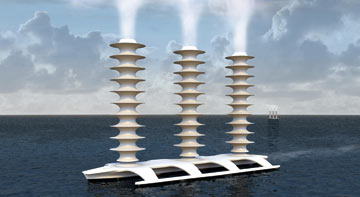
Autonomous ship designed to create reflective marine clouds

I believe that some of these ideas could actually work (I think the one about cloud forming ships is cool). In some cases these ideas might even be cheaper than reducing emissions sufficiently.

However, I also feel that geo-engineering solutions have some very serious weaknesses:

  • Most plans have known and, more dangerously, unknown side effects.
  • If greenhouse gas levels were to continue increasing, we would have to continue ramping up the geo-engineering -> more side effects.
  • In almost all cases, the geo-engineering does not solve the other problems associated with high greenhouse gas levels.

Geo-engineering is a cool concept, but I really don’t think we should be experimenting on the planet.  Lets try to make Mars habitable instead!

Outing to Cape Point

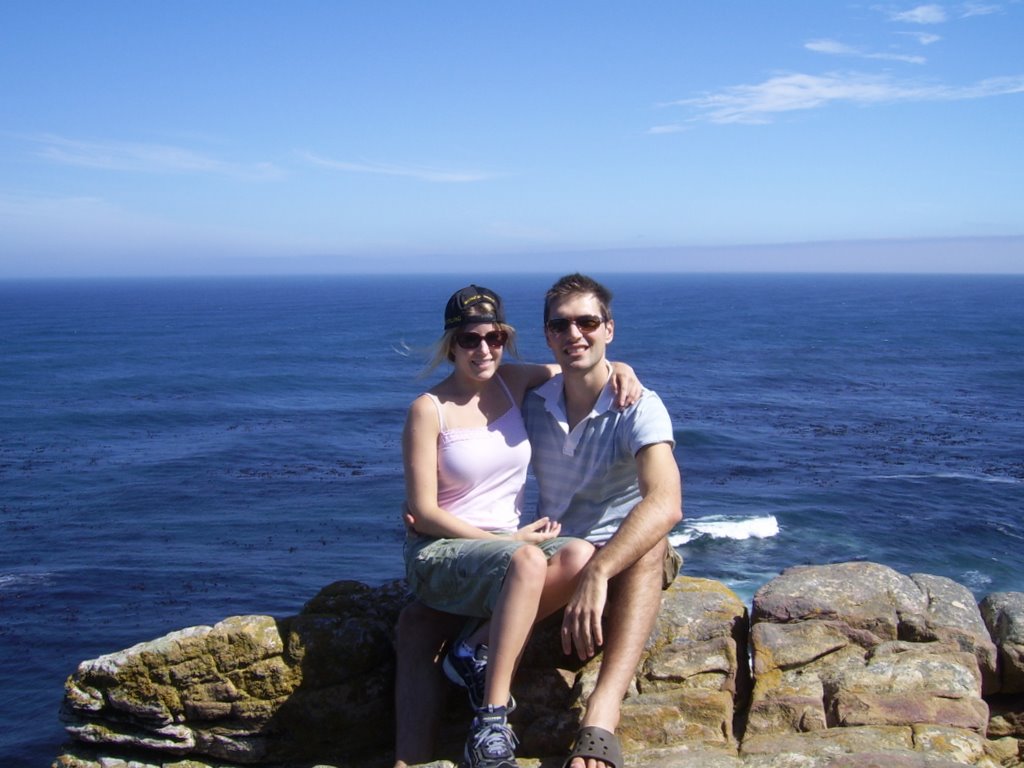
Me at Cape Point

Yesterday was Human Rights day so Jules and I headed off to have a look around at Cape Point. It is really beautiful out there and we enjoyed a good hike along the coast up to the lighthouse. I haven’t been to many places in South Africa where you get cliffs dropping down into the ocean so it was an interesting hike. We also saw some wildlife – baboons, zebra, dolphins, ostriches and hartebeest (although we only noticed them in out photos when we got home!).A enjoyable outing – although I wouldn’t recommend it if you don’t like wind!

Jules and I having a great time at Cape Point

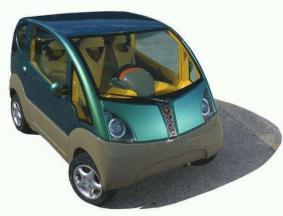
Cars running on compressed air to be produced by Tata

Compressed air city carGizmag have an article on a car which Tata is going to produce which runs on compressed air.  This means the only impact on the environment is the energy used to actually compress the air.  The exhaust fumes are just cool, unpolluted air!

The company says that the car will cost about R30 to fill up at air pumps at upgraded petrol stations.  It will then be able to travel 200 to 300 km with a max speed of about 110 km/h.

If this actually works it will be great for cities.  Almost no pollution and cheap to run.

Clouded leopards

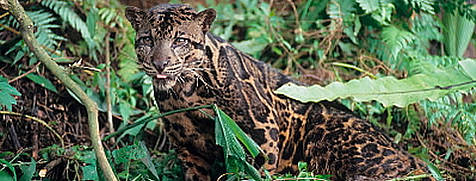
Clouded leopard

What a beauty! I had never even heard of this species of cat until recently – the variety of nature never ceases to amaze. Clouded leopards have been in the news recently because some scientists have (somewhat controversially) claimed to have found a new species in Borneo.

Network Neutrality

I suppose that if you aren’t a geek (like me) you may not have heard of the “Net Neutrality” debate. I think that it’s actually quite an interesting (and important) argument.

What is net neutrality? Net neutrality is the principle that network operators (like Telkom or AT&T) should give equal treatment to all the traffic on their networks.

Currently, the internet blindly delivers data packets regardless of what they contain. The network just gets data and passes it on – no matter what is in there. This is what makes the internet flexible – anyone can send anything they want.

In the US the telecoms firms (AT&T, Verizon, etc) want to be allowed to charge content providers (e.g. Google, BBC, any web site) a fee for providing their content on a faster connection. In effect, they plan “express toll lanes” alongside the internet’s existing highways.

They are promising to leave the normal traffic as it is – they just want to have special lanes for people who pay more. Sounds fair(ish).

There are a few reasons why I don’t like this idea:

  • Why would the operators upgrade the normal networks if they could be making more money by upgrading the expensive ones?
  • This would tilt the internet toward the big sites. Little sites like www.alistairpott.com are going to be much slower than the big boys.
  • Once a few sites pay up they will all be sucked in. If Google pays for faster delivery then Yahoo! will have to follow.

So I don’t like the idea of allowing operators to violate network neutrality. But, I hate over-regulation so I don’t think that over-strict rules should be put in place the preserve neutrality. As usual, I think the guys at The Economist have got the right idea:
“A minimal set of rules to protect net neutrality would still leave room for operators to experiment with new premium services.”

Google’s stance on net neutrality

Game theory model of the effects of removing network neutrality

Hole through the Earth

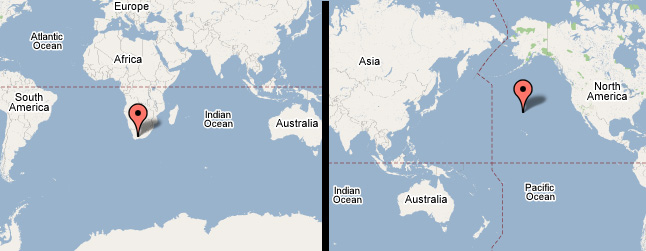
Where would you come out if you were to dig a hole through the earth from Cape Town? Somewhere in the middle of the Pacific!

Hole through the Earth

This site has a program which allows you to check out the opposite side of the world from any location. What’s pretty interesting is that almost all land on earth is opposite ocean (except at the poles obviously). Africa and Europe are opposite the Pacific Ocean; North America and most of South America are opposite the Indian Ocean.

I wonder if there is more too that…

Lorem Ipsum

What the? Lorem Ipsum you too man…

Actually, Lorem Ipsum is the name of the dummy text that is most commonly used for layout previews/examples. It’s used to show what a webpage/pamphlet/book/etc would look like populated with text. The guys who do this for a living know that the reader will be distracted by the readable content of a page when looking at its layout.

So instead they use a passage of classical Latin literature written in 45 BC. The really cool thing (in my opinion) is that it has been in use since the 1500’s!

Here is a page devoted to it. Also has a generator.

The Argus was great

Leaving for the start of the 2007 Cape ArgusThe weather was great, the crowds were out in force, and it was really fun to do the Argus again. Because I haven’t done it for a few years I had a late start group – 10h30. I even watched the earlier groups finishing the race on TV before leaving to start!

I hadn’t done much training (total 140km for a race of 109km) but I was able to rely on general fitness and I managed finished with a time of 3:57:39 – way better than my target. Still only good enough for 12,059th out of 28,706 finishers!

What a race…

The Shower-Curtain Effect

Shower-Curtain EffectQuite often in the past I have noticed that after turning on a shower, the curtain will billow in toward me – infuriatingly. I thought about it and figured that the hot water was heating the air in the shower and causing it to rise. This in turn would create a low pressure causing cool air from outside the shower to blow inwards.

However, this theory fails because the curtain blows in on a cold shower too… So I looked it up and it turns out this is a well known problem. A scientist (David Schmidt of University of Massachusetts) who specialises in fluid dynamics built a computer model of the problem which produced the results seen above.

Basically, the water flow is causing a vortex in the shower which lowers the air pressure and drags in the curtain. The effect isn’t very strong so it is easy overcome by heavier shower curtains.

Wikipedia on the effect

Detailed explanation